Half There: Why Every Show Is Now Written for the Corner of Your Eye
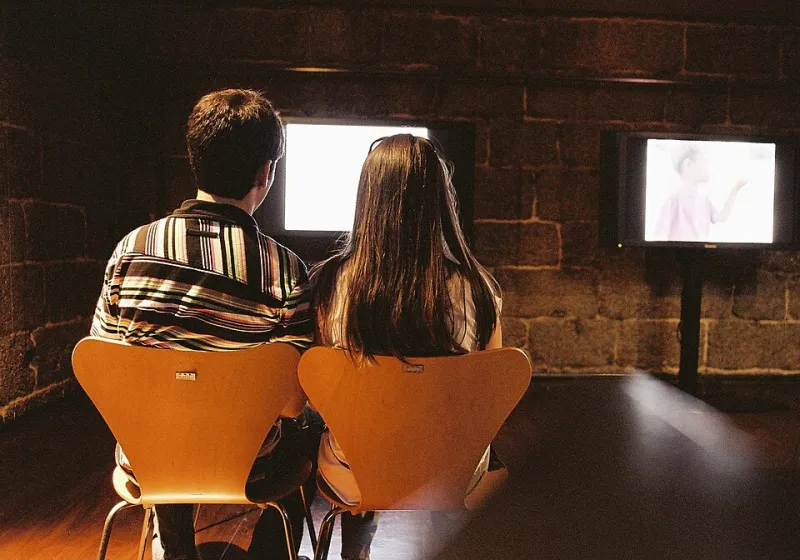
Photo: Miguel Pires da Rosa from Braga, Portugal, CC BY-SA 2.0, via Wikimedia Commons
Somewhere in the last few years, the way we watch things quietly changed shape. Not the screens — those got bigger, then smaller, then somehow both. The behavior. Sit down for a new episode of anything and count how long it takes before your phone is in your hand. For most of us, the honest answer is: it was already there.
We used to call this multitasking. Now it's just watching TV.
The default setting is distracted
Ask people what they did during the finale of a show they claim to love and you'll hear a lot of "I was also..." — also on Reddit, also texting a friend, also half-heartedly shopping for a duvet cover. The show is the soundtrack to the rest of the evening. It's the thing happening while other things happen.
That's not a moral failing. It's a design outcome. The phone is a slot machine that never closes, and a nine-episode season is a low-stakes bet. If the episode loses you for ninety seconds, there's no penalty. You don't have to leave the room. You just drift down the timeline and come back for the chorus.
Nobody writes for the back of the room anymore
Here's where it gets interesting. The industry knows. Second-screen behavior has been a fixture of streaming data for years, and the response hasn't been to fight it — it's been to accommodate it.
That accommodation shows up everywhere once you start looking for it:
- Recaps that are basically apologies. Characters state their motivations out loud because someone might have missed the setup two scenes ago. Subtext is a liability.
- Dialogue that explains the plot. Not because the writers think you're dumb, but because they know you were in the kitchen.
- Volume-normalized sound mixes. The big emotional swell gets flattened so it doesn't get lost under a TikTok audio track bleeding out of your phone speaker.
- Shows built around set pieces and quotable moments rather than slow accumulation, because a screenshot or a clip has to survive on its own.
None of this is a conspiracy. It's just a rational response to what the data says about eyeballs. And the data says the eyeballs come and go.
The watercooler has a lag problem
What we lost in the trade is harder to measure, because it doesn't show up in a retention graph.
There was a specific pleasure in a shared cultural moment — everyone at work Monday, nobody spoiling anything, all of us sitting in the same suspense at the same time. Appointment television. Even the phrase sounds antique. That experience depended on a scarce resource: attention, undivided, simultaneous.
That scarcity is gone. One person binges the whole season on Friday night. Another is on episode three and dodging spoilers. A third watched a recap on YouTube and considers themselves caught up. A fourth has only seen the promotional clips, which, honestly, is often enough.
A shared moment requires everyone to be in the same place at the same time, and streaming's entire promise is that nobody ever has to be. So the culture doesn't fracture dramatically. It just thins out. There are fewer things we all know together, and the ones we do know, we know shallowly.
What actually gets made for a distracted audience
Because here's the thing I keep circling back to. You can build a show for the corner of someone's eye, but you can't build a great one that way — not reliably. The work that rewards divided attention is work that's already sturdy on the first watch: procedurals, competition shows, reality formats, anything where missing a beat costs you nothing.
The stuff that requires you to stay — the slow burn, the twist that recontextualizes an hour you already sat through, the scene where nothing happens except a look — that work is now competing against a phone that's always warmer than the show. It still gets made. But it gets made with a hedge, and often it gets cancelled before the audience that would have shown up in a quieter world ever finds it.
Which is the real cost. Not that television got dumber. That the kind of television that demands something of you now has to win an argument every eleven minutes, against a device engineered to be more interesting than anything.
You can still choose
The one thing that hasn't been automated yet is the decision to put the phone in the other room. I know how that sounds — like a wellness tip, which I promise this isn't. It's just an observation about leverage. The industry will keep optimizing for the version of you that's half there, because that version is more profitable and always available.
The fully present version of you has to be chosen. And it's worth remembering what that feels like, because it's the only condition under which a show can actually land the way it was meant to.