Letting Go to Hold On: The Counterintuitive Secret Behind Real Creative Power
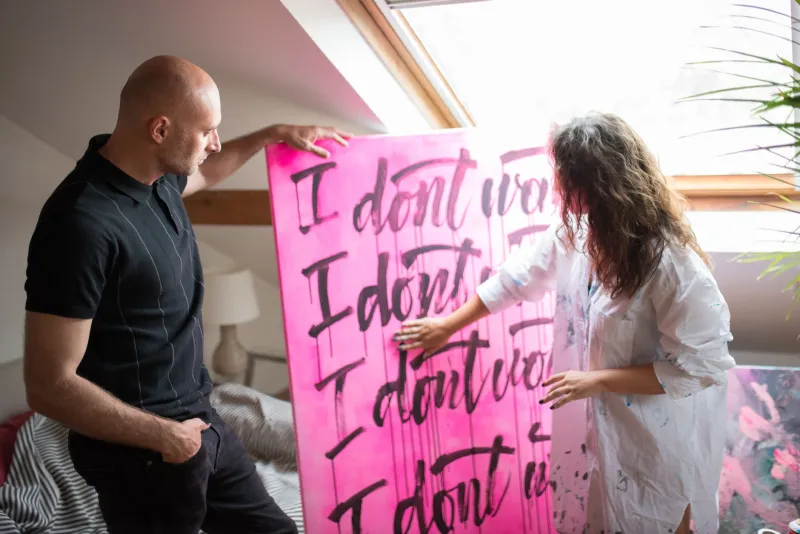
There's this image we have of the visionary artist — the one who touches every detail, approves every decision, sleeps four hours a night because nobody else could possibly understand the work the way they do. We romanticize that level of control. We call it dedication. We call it integrity. Sometimes we even call it genius.
But here's the thing: a lot of those artists burn out, get swallowed by the business side of their own careers, or end up making watered-down versions of their best work because they're too exhausted to access it. The control they were protecting so fiercely? It slipped away anyway — just slowly, and from the inside.
The creators who seem to have the most enduring artistic authority aren't always the ones running the tightest ship. Sometimes they're the ones who figured out, early or eventually, that strategic delegation isn't surrender. It's infrastructure.
The Trap of Total Ownership
When you're starting out, doing everything yourself makes complete sense. You don't have resources, you don't have a team, and honestly, you don't fully trust anyone else to care about your work the way you do. That scrappy, hands-on phase is real and necessary. It teaches you what everything looks like from the inside.
But a lot of creators never mentally leave that phase, even after their careers grow well beyond it. They keep operating like it's still just them in a studio apartment answering every email and editing every frame. And the problem isn't that they care too much — it's that they're spending creative energy on things that don't require their particular genius.
Every hour a talented director spends negotiating licensing deals is an hour they're not developing their next project. Every hour a musician spends managing their own social media calendar is an hour they're not in the studio. The work suffers not because of laziness, but because bandwidth is finite and creative depth requires sustained, protected attention.
What Beyoncé Actually Taught Us About Control
Consider how Beyoncé operates. She's one of the most image-controlled artists in modern entertainment — and yet she has an entire infrastructure of collaborators, directors, choreographers, stylists, and business managers working under and alongside her. She doesn't do everything. What she does is define the vision so clearly that everyone working in her orbit knows exactly what they're building toward.
That's a different kind of control. It's not micromanagement — it's architecture. She's not holding every brick; she drew the blueprint.
Or look at someone like Taylor Swift, who spent years inside a system that didn't serve her creative or business interests, then methodically rebuilt her career by delegating the right things to the right people while personally reclaiming ownership of the decisions that mattered most — her masters, her narrative, her release strategy. The public saw a power move. What actually happened was a careful sorting of what needed her direct hand and what didn't.
The Art of Knowing What's Actually Yours to Protect
This is where a lot of creators get stuck. They treat all decisions as equally important because they're all technically about their career. But they're not equal. Some decisions are load-bearing walls. Others are paint color.
Load-bearing decisions — the ones that shape what you make, why you make it, and what it says — those you protect fiercely. The creative vision, the values embedded in the work, the long-term direction of what you're building. That's yours.
Everything else is potentially delegable. Your inbox. Your brand partnerships inbox. Your analytics. Your scheduling. Your comment moderation. Your merch logistics. None of that requires your specific artistic sensibility. What it requires is competence, organization, and alignment with your values — and those are things you can hire for or build systems around.
The artists who figure this out early often describe the same experience: once they stopped drowning in the operational noise, they could finally hear themselves think creatively again. The work got better. The vision got clearer. Ironically, they felt more in control, not less.
When Letting Go Goes Wrong
It's worth being honest that this doesn't always work cleanly. There are real cautionary tales of artists who delegated too broadly, too early, or to the wrong people — and ended up with someone else quietly steering their career while they focused on the craft. The music industry is full of those stories. So is Hollywood.
The difference between strategic delegation and losing the wheel is specificity. You have to know what you're handing off, to whom, with what guardrails, and with what check-ins. Handing your business affairs to a manager you trust isn't the same as handing them your creative direction. Letting a social media team handle your posting schedule isn't the same as letting them define your public voice.
Artists who've been burned by this usually describe the same thing in retrospect: they weren't clear enough about where their authority ended and someone else's began. The lines blurred, and by the time they noticed, the drift had been going on for years.
So the framework isn't just "let go of more" — it's "let go of the right things, clearly and intentionally."
The Deeper Shift
There's something almost philosophical underneath all of this. A lot of creative anxiety about control is actually anxiety about identity. If I'm not the one making every call, am I still really the author of this work? If other people are involved in executing my vision, does it still count as mine?
Most working artists eventually arrive at a more relaxed answer to that question. The work is yours when the animating idea is yours, when the values running through it are yours, when the direction it moves in reflects your genuine creative instincts. Execution can be collaborative. Vision is singular.
The creators who've built long, creatively rich careers tend to understand this not as a compromise but as a maturation. Holding on to everything isn't strength — it's often fear wearing the costume of integrity.
Real control, it turns out, is less about doing everything and more about knowing exactly what you'll never let someone else touch — and being completely free inside that space.
That's where the actual work lives. And protecting that? That's the whole job.